CHILI RECIPE
source (google.com)Chili con carne (Spanish pronunciation English: chili with meat), commonly known in American English as simply "chili", is a spicy stew containing chili peppers, meat (usually beef), and often tomatoes and beans. Other seasonings may include garlic, onions, and cumin. Geographic and personal tastes involve different types of meat and ingredients. Recipes provoke disputes among aficionados, some of whom insist that the word "chili" applies only to the basic dish, without beans and tomatoes. Chili con carne is a frequent dish for cook-offs and is used as an ingredient in other dishes.
In Spanish, the word chile from the Nahuatl "chīlli" refers to a "chili pepper", and carne is Spanish for "meat".
A recipe, found as far back as 1850, consisted of dried beef, suet, pepper, salt and chilli peppers. The ingredients were pounded together and formed into stackable rectangles. The resulting dried mixture could be rehydrated by boiling in pots on the trail.[2]
The San Antonio Chili Stand, in operation at the 1893 Columbian Exposition in Chicago, helped popularize chili by allowing Americans to appreciate its taste. San Antonio was a tourist destination and helped Texas-style chili con carne spread throughout the South and West.[3] Chili con carne is the official dish of the U.S. state of Texas as designated by the House Concurrent Resolution Number 18 of the 65th Texas Legislature during its regular session in 1977.[4]
Chili parlors
Before World War II, hundreds of small, family-run chili parlors (also known as "chili joints") could be found throughout Texas and other states, particularly those in which émigré Texans had made new homes. Each establishment usually had a claim to some kind of secret recipe.
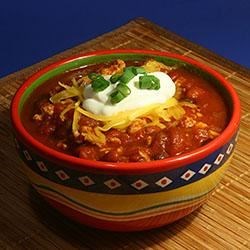
A bowl of chili con carne and tortilla chips.
Cincinnati chili arguably represents the most vibrant continuation of the chili parlor tradition, with dozens of restaurants offering this style throughout the Cincinnati area. It can be traced back to at least 1922, when the original Empress Chili location opened.[6]
In Green Bay, Wisconsin, the chili parlor Chili John's has existed since 1913. As with Cincinnati chili, it is most commonly served over spaghetti with oyster crackers, but the recipe is less sweet with a higher proportion of fat.[7] The original proprietor's son opened a second location in Burbank in 1946, which is also still in existence.[8]
Until the late 2000s, a chili parlor dating to 1904, O.T. Hodge, continued to operate in St. Louis. It featured a chili-topped dish called a "slinger": two cheeseburger patties, hash browns, and two eggs, and smothered in chili.[9] As of 2014 no O.T. Hodge-branded locations remain, though one still exists under the name Chili Mac's.[10]
Controversy over ingredients
ingredients for chili con carne.
A bowl of Texas-style chili without beans.
In some areas, specifically the American South, versions with beans are referred to as "chili beans"[citation needed] while the term "chili" is reserved for the all-meat dish. Small red beans are commonly used for chili, as are black-eyed peas, kidney beans, great northern beans, or navy beans. Chili bean can refer to a small red variety of common bean also known as the pink bean. The name may have arisen from that bean's resemblance to small chili peppers, or it may be a reference to that bean's inclusion in chili recipes.
Most commercially prepared canned chili includes beans. Commercial chili prepared without beans is usually called "chili no beans" in the United States. Some U.S. manufacturers, notably Bush Brothers and Company and Eden Organic, also sell canned precooked beans (without meat) that are labeled "chili beans"; these beans are intended for consumers to add to a chili recipe and are often sold with spices added.
Tomatoes are another ingredient on which opinions differ. Wick Fowler, north Texas newspaperman and inventor of "Two-Alarm Chili" (which he later marketed as a "kit" of spices), insisted on adding tomato sauce to his chili — one 15-oz. can per three pounds of meat. He also believed that chili should never be eaten freshly cooked but refrigerated overnight to seal in the flavor. Matt Weinstock, a Los Angeles newspaper columnist, once remarked that Fowler's chili "was reputed to open eighteen sinus cavities unknown to the medical profession.Vegetarian chili (also known as chili sin carne, chili without meat, chili non carne, and chili sans carne) acquired wide popularity in the U.S. during the 1960s and 1970s with the rise of vegetarianism. It is also popular with those on a diet restricting the use of red meat. To make the chili vegetarian, the cook leaves out the meat or replaces it with a meat analogue, such as textured vegetable protein or tofu, or a starchy vegetable, such as potatoes. These chilis nearly always include beans. Variants may contain corn, squash, mushrooms, or beets.
CHILI RECIPE

CHILI RECIPE

CHILI RECIPE

CHILI RECIPE
CHILI RECIPE
CHILI RECIPE

CHILI RECIPE

CHILI RECIPE

CHILI RECIPE

CHILI RECIPE

CHILI RECIPE

CHILI RECIPE

CHILI RECIPE

CHILI RECIPE
CHILI RECIPE

CHILI RECIPE

CHILI RECIPE

CHILI RECIPE
CHILI RECIPE

No comments:
Post a Comment